Sunday, May 6, 2012

"How to End This Depression" by Paul Krugman

Is it possible to solve the depression and return the economy to full employment without severe austerity measures? Has the political response in Western Europe, wherein Germany argues for greater austerity measures in the struggling Southern economies, been successful? A strong consensus is building among prominent economists, historians, and politicians that the depression and high unemployment can be solved relatively easily and quickly. All that is needed is to understand the historical patterns of economic recovery after financial crisis and to muster up the necessary political will to create policies that are in accordance with the economic truth. Paul Krugman, the professor of economics and international affairs at Princeton University and Nobel Laureate in Economics, argues in his forthcoming book that the depression we are experiencing is not necessary and that the right policies can have a significant affect on the depressed labor markets and economic system. The following article gives a brief summary of Krugman's argument.      

PRINCETON-The depression we’re in is essentially gratuitous: we don’t need to be suffering so much pain and destroying so many lives. We could end it both more easily and more quickly than anyone imagines—anyone, that is, except those who have actually studied the economics of depressed economies and the historical evidence on how policies work in such economies.

The truth is that recovery would be almost ridiculously easy to achieve: all we need is to reverse the austerity policies of the past couple of years and temporarily boost spending. Never mind all the talk of how we have a long-run problem that can’t have a short-run solution—this may sound sophisticated, but it isn’t. With a boost in spending, we could be back to more or less full employment faster than anyone imagines.

But don’t we have to worry about long-run budget deficits? Keynes wrote that “the boom, not the slump, is the time for austerity.” Now, as I argue in my forthcoming book—and show later in the data discussed in this article—is the time for the government to spend more until the private sector is ready to carry the economy forward again. At that point, the US would be in a far better position to deal with deficits, entitlements, and the costs of financing them.

Meanwhile, the strong measures that would all go a long way toward lifting us out of this depression should include, among other policies, increased federal aid to state and local governments, which would restore the jobs of many public employees; a more aggressive approach by the Federal Reserve to quantitative easing (that is, purchasing bonds in an attempt to reduce long-term interest rates); and less timid efforts by the Obama administration to reduce homeowner debt.

But some readers will wonder, isn’t a recovery program along the lines I’ve described just out of the question as a political matter? And isn’t advocating such a program a waste of time? My answers to these two questions are: not necessarily, and definitely not. The chances of a real turn in policy, away from the austerity mania of the last few years and toward a renewed focus on job creation, are much better than conventional wisdom would have you believe. And recent experience also teaches us a crucial political lesson: it’s much better to stand up for what you believe, to make the case for what really should be done, than to try to seem moderate and reasonable by essentially accepting your opponents’ arguments. Compromise, if you must, on the policy—but never on the truth.

Let me start by talking about the possibility of a decisive change in policy direction.

Nothing Succeeds Like Success

Pundits are always making confident statements about what the American electorate wants and believes, and such presumed public views are often used to wave away any suggestion of major policy changes, at least from the left. America is a “center-right country,” we’re told, and that rules out any major initiatives involving new government spending.

And to be fair, there are lines, both to the left and to the right, that policy probably can’t cross without inviting electoral disaster. George W. Bush discovered that when he tried to privatize Social Security after the 2004 election: the public hated the idea, and his attempted juggernaut on the issue quickly stalled. A comparably liberal-leaning proposal—say, a plan to introduce true “socialized medicine,” making the whole health care system a government program like the Veterans Health Administration—would presumably meet the same fate. But when it comes to the kind of policy measures I have advocated—measures that would mainly try to boost the economy rather than try to transform it—public opinion is surely less coherent and less decisive than everyday commentary would have you believe.

Pundits and, I’m sorry to say, White House political operatives like to tell elaborate tales about what is supposedly going on in voters’ minds. Back in 2011 The Washington Post’s Greg Sargent summarized the arguments Obama aides were using to justify a focus on spending cuts rather than job creation:

A big deal would reassure independents who fear the country is out of control; position Obama as the adult who made Washington work again; allow the President to tell Dems he put entitlements on sounder financial footing; and clear the decks to enact other priorities later.
Any political scientist who has actually studied electoral behavior will scoff at the idea that voters engage in anything like this sort of complicated reasoning. And political scientists in general have scorn for what Slate’s Matthew Yglesias calls the pundit’s fallacy, the belief on the part of all too many political commentators that their pet issues are, miraculously, the very same issues that matter most to the electorate.

Most real voters are busy with their jobs, their children, and their lives in general. They have neither the time nor the inclination to study policy issues closely, let alone engage in opinion-page-style parsing of political nuances. What they notice, and vote on, is whether the economy is getting better or worse; statistical analyses say that the rate of economic growth in the three quarters or so before the election is by far the most important determinant of electoral outcomes. (read more)

Thursday, May 3, 2012

The Austerity Debates: Old vs. New Ways of Economic Thinking

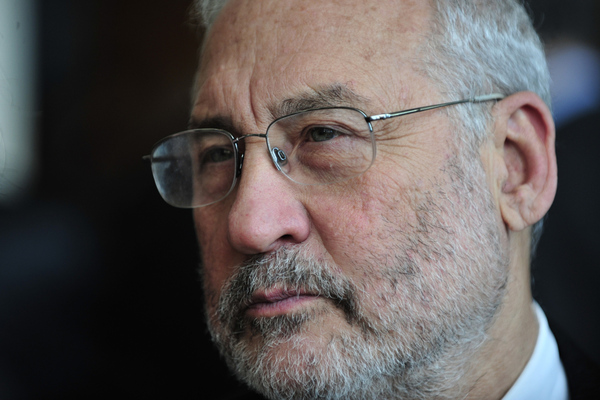
The 2008 financial crisis has evolved through many stages and now  centers around the role of the state to stabilize markets while minimizing deficits. As one would predict, this has led to highly contentious debates both in America and Western Europe regarding the role of the state versus private actors to stabilize the economic system, the importance of long-term financial stability versus short-term growth, and the role of old versus new ways of economic thinking. These debates center around the following questions: should the state implement pro-growth strategies even though it is struggling to deal with decreasing tax revenue and increasing sovereign debt? Should a pro-growth agenda be put on hold to allow strong austerity measures to take affect? Global leaders, economic organizations, and governments around the world have taken different positions regarding these questions. Below is an insightful interview with Joseph Stiglitz--the Nobel Prize winning economist, co-founder of the Institute for New Economic Thinking (INET), and professor at Columbia University--that helps us understand the underlying conflicts in the academy and among politicians, and the potential solutions that are possible.

Question: Four years after the beginning of the financial crisis, are you encouraged by the ways in which economists have tried to make sense of it, and by the ways in which those insights have been taken up by policy makers? 

Stiglitz: Let me break this down in a slightly different way. Academic economists played a big role in causing the crisis. Their models were overly simplified, distorted, and left out the most important aspects. Those faulty models then encouraged policy-makers to believe that the markets would solve all the problems. Before the crisis, if I had been a narrow-minded economist, I would have been very pleased to see that academics had a big impact on policy. But unfortunately that was bad for the world. After the crisis, you would have hoped that the academic profession had changed and that policy-making had changed with it and would become more skeptical and cautious. You would have expected that after all the wrong predictions of the past, politics would have demanded from academics a rethinking of their theories. I am broadly disappointed on all accounts.

Question: Economists have seen the flaws of their models but have not worked to discard or improve them? 

Stiglitz: Within academia, those who believed in free markets before the crisis still do so today. A few people have shifted, and I want to give credit to them for saying: “We were wrong. We underestimated this or that aspect of our models.” But for the most part, the response was different. Believers in the free market have not revised their beliefs.

Question: So let’s take a longer view. Do you think that the crisis will have an effect on future generations of economists and policy-makers, for example by changing the way that economic basics are taught? 

Stiglitz: I think that change is really occurring with the young people. My young students overwhelmingly don’t understand how people could have believed in the old models. That is good. But on the other hand, many of them say that if you want to be an economist, you still have to deal with all the old guys who believe in their wrong theories, who teach those theories, and expect you to believe in them as well. So they choose not to go into those branches of economics. But where I have been even more disappointed is American policy-making. Ben Bernanke gives a speech and says something like, there was nothing wrong with economic theory, the problems were a few details in implementation. In fact, there was a lot wrong with economic theory and with the basic policy framework that was derived from theory. If your mindset is that nothing was wrong, you will not demand new models. That’s a big disappointment.

Question: There seemed to have been quite a bit of disagreement among Obama’s economic advisers about the right course of action. And in Europe, fundamental economic principles like the absolute focus on GDP growth have finally come under attack. 

Stiglitz: Some American policy-makers have recognized the danger of “too big to fail,” but they are a minority. In Europe, things are a bit better on the rhetorical side. Influential economists like Derek Turner and Mervyn King have recognized that something is wrong. The Vickers Commission has thoughtfully re-examined economic policy. We have nothing like that in the United States. In Germany and France, the financial transactions tax and limits to executive compensation are on the table. Sarkozy says that capitalism hasn’t worked, Merkel says that we were saved by the European social model – and they are both conservative politicians! The bankers still don’t understand this, which explains why we still see the head of the European Central Bank, Mario Draghi, arguing that we have to give up the welfare system at a time when Merkel says the exact opposite: That the social model kept us going when the central banks failed to do their regulatory job and used politics to change the nature of our societies.

Question: How have your own convictions been affected by the crisis? 

Stiglitz: I don’t think that there has been a fundamental change in my thinking. The crisis has reinforced certain things I said before and shown me how important they are. In 2003, I wrote about the risk of interdependence, where the collapse of one bank can bring about the collapse of other banks and increase the fragility of the banking system. I thought it was important, but the idea wasn’t picked up at the time. The same year we looked at agency problems in finance. Now we recognize just how important those issues are. I argued that the real issue in monetary economics is about credit, not money supply. Now everybody recognizes that the collapse of the credit system brought down the banks. So the crisis really validated and reinforced several strands of theory that I had explored before. One topic that I now consider much more important than I did previously is the question of adjustment and the role of exchange rate systems like the Euro in preventing economic adjustment. A related issues is the linkage between structural adjustment and macroeconomic activity. The events of the crisis have really induced me to think more about them.

Question: The financial transaction tax seems to have died a political death in Europe. Now, economic policy in Europe seems largely dominated by the logic of austerity, and by forcing other European countries to become more like Germany.

Stiglitz: Austerity itself will almost surely be disastrous. It is leading to a double-dip recession that could be quite serious. It will probably make the Euro crisis worse. The short-term consequences are going to be very bad for Europe. But the broader issue is about the “German model.” There are many aspects to it – among them the social model – that allow Germany to weather a very big dip in GDP by offering high levels of social protection. The German model of vocational training is also very successful. But there are other characteristics that are not so good. Germany is an export economy, but that cannot be true for all countries. If some countries have export surpluses, they are forcing other countries to have export deficits. Germany has taken a policy that other countries cannot imitate and tried to apply it to Europe in a way that contributes to Europe’s problems. The fact that some aspects of the German model are good does not mean that all aspects can be applied across Europe.

Question: And it does not mean that economic growth satisfied the criteria of social fairness. 

Stiglitz: Yes, so there is one other thing we have to take into account: What is happening to most citizens in a country? When you look at America, you have to concede that we have failed. Most Americans today are worse off than they were fifteen years ago. A full-time worker in the US is worse off today than he or she was 44 years ago. That is astounding – half a century of stagnation. The economic system is not delivering. It does not matter whether a few people at the top benefitted tremendously – when the majority of citizens are not better off, the economic system is not working. We also have to ask of the German system whether it has been delivering. I haven’t studied all the data, but my impression is no.

Question: What do you say to someone who argues thus: Demographic change and the end of the industrial age have made the welfare state financially unsustainable. We cannot expect to cut down on our debt without fundamentally reducing welfare costs in the long run.

Stiglitz: That is absurd. The question of social protection does not have to do with the structure of production. It has to do with social cohesion or solidarity. That is why I am also very critical of Draghi’s argument at the European Central Bank that social protection has to be undone. There are no grounds upon which to base that argument. The countries that are doing very well in Europe are the Scandinavian countries. Denmark is different from Sweden, Sweden is different from Norway – but they all have strong social protection and they are all growing. The argument that the response to the current crisis has to be a lessening of social protection is really an argument by the 1% to say: “We have to grab a bigger share of the pie.” But if the majority of people don’t benefit from the economic pie, the system is a failure. I don’t want to talk about GDP anymore, I want to talk about what is happening to most citizens.

Question: Has the political Left been able to articulate that criticism? 

Stiglitz: Paul Krugman has been very strong on articulating criticism of the austerity arguments. The broader attack has been made, but I am not sure whether it has been fully heard. The critical question right now is how we grade economic systems. It hasn’t been fully articulated yet but I think we will win this one. Even the Right is beginning to agree that GDP is not a good measure of economic progress. The notion of the welfare of most citizens is almost a no-brainer.

Question: It seems to me that much of the discussion is still about statistical measurements – if we’re not measuring GDP, we’re measuring something else, like happiness or income differences. But is there an element to these discussions that cannot be put in numerical terms – something about the values we implicitly bake into our economic system? 

Stiglitz: In the long run, we ought to have those ethical discussions. But I am beginning from a much narrower base. We know that income doesn’t reflect many things we care about. But even with an imperfect indicator such as income, we should care about what happens to most citizens. It’s nice that Bill Gates is doing well. But if all the money went to Bill Gates, the system could not be graded as successful.

Question: If the political Left hasn’t been able to fully articulate that idea, has civil society been able to fill the gap? 

Stiglitz: Yes, the Occupy movement has been very successful in bringing those ideas to the forefront of political discussion. I wrote an article for Vanity Fair in 2011 – “Of the 1%, by the 1%, for the 1%” – that really resonated with a lot of people because it spoke to our worries. Protests like the ones at Occupy Wall Street are only successful when they pick up on these shared concerns. There was one newspaper article that described the rough police tactics in Oakland. They interviewed many people, including police officers, who said: “I agree with the protesters.” If you ask about the message, the overwhelming response has been supportive, and the big concern has been that the Occupy movement hasn’t been effective enough in getting that message across. (read more)

Wednesday, March 14, 2012

"What Isn't for Sale?" by Michael J. Sandel

Market thinking so permeates our lives that we barely notice it anymore. In the following article by Michael J. Sandel, political philosopher and the Anne T. and Robert M. Bass Professor of Government at Harvard University, attention is drawn to the fact that there is a difference between a market economy and market society, and that we as a society need to decide the limitations of markets. Specifically, Sandel argues that the great missing debate in contemporary politics is about the role and reach of markets. Do we want a market economy, or a market society? What role should markets play in public life and personal relations? How can we decide which goods should be bought and sold, and which should be governed by nonmarket values? Where should money’s writ not run?   

CAMBRIDGE - We live in a time when almost everything can be bought and sold. Over the past three decades, markets—and market values—have come to govern our lives as never before. We did not arrive at this condition through any deliberate choice. It is almost as if it came upon us.

As the Cold War ended, markets and market thinking enjoyed unrivaled prestige, and understandably so. No other mechanism for organizing the production and distribution of goods had proved as successful at generating affluence and prosperity. And yet even as growing numbers of countries around the world embraced market mechanisms in the operation of their economies, something else was happening. Market values were coming to play a greater and greater role in social life. Economics was becoming an imperial domain. Today, the logic of buying and selling no longer applies to material goods alone. It increasingly governs the whole of life.

The years leading up to the financial crisis of 2008 were a heady time of market faith and deregulation—an era of market triumphalism. The era began in the early 1980s, when Ronald Reagan and Margaret Thatcher proclaimed their conviction that markets, not government, held the key to prosperity and freedom. And it continued into the 1990s with the market-friendly liberalism of Bill Clinton and Tony Blair, who moderated but consolidated the faith that markets are the primary means for achieving the public good.

Today, that faith is in question. The financial crisis did more than cast doubt on the ability of markets to allocate risk efficiently. It also prompted a widespread sense that markets have become detached from morals, and that we need to somehow reconnect the two. But it’s not obvious what this would mean, or how we should go about it.

Some say the moral failing at the heart of market triumphalism was greed, which led to irresponsible risk-taking. The solution, according to this view, is to rein in greed, insist on greater integrity and responsibility among bankers and Wall Street executives, and enact sensible regulations to prevent a similar crisis from happening again.

This is, at best, a partial diagnosis. While it is certainly true that greed played a role in the financial crisis, something bigger was and is at stake. The most fateful change that unfolded during the past three decades was not an increase in greed. It was the reach of markets, and of market values, into spheres of life traditionally governed by nonmarket norms. To contend with this condition, we need to do more than inveigh against greed; we need to have a public debate about where markets belong—and where they don’t.

Consider, for example, the proliferation of for-profit schools, hospitals, and prisons, and the outsourcing of war to private military contractors. (In Iraq and Afghanistan, private contractors have actually outnumbered U.S. military troops.) Consider the eclipse of public police forces by private security firms—especially in the U.S. and the U.K., where the number of private guards is almost twice the number of public police officers.

Or consider the pharmaceutical companies’ aggressive marketing of prescription drugs directly to consumers, a practice now prevalent in the U.S. but prohibited in most other countries. (If you’ve ever seen the television commercials on the evening news, you could be forgiven for thinking that the greatest health crisis in the world is not malaria or river blindness or sleeping sickness but an epidemic of erectile dysfunction.)

Consider too the reach of commercial advertising into public schools, from buses to corridors to cafeterias; the sale of “naming rights” to parks and civic spaces; the blurred boundaries, within journalism, between news and advertising, likely to blur further as newspapers and magazines struggle to survive; the marketing of “designer” eggs and sperm for assisted reproduction; the buying and selling, by companies and countries, of the right to pollute; a system of campaign finance in the U.S. that comes close to permitting the buying and selling of elections.

These uses of markets to allocate health, education, public safety, national security, criminal justice, environmental protection, recreation, procreation, and other social goods were for the most part unheard-of 30 years ago. Today, we take them largely for granted.

Why worry that we are moving toward a society in which everything is up for sale?

For two reasons. One is about inequality, the other about corruption. First, consider inequality. In a society where everything is for sale, life is harder for those of modest means. The more money can buy, the more affluence—or the lack of it—matters. If the only advantage of affluence were the ability to afford yachts, sports cars, and fancy vacations, inequalities of income and wealth would matter less than they do today. But as money comes to buy more and more, the distribution of income and wealth looms larger.

The second reason we should hesitate to put everything up for sale is more difficult to describe. It is not about inequality and fairness but about the corrosive tendency of markets. Putting a price on the good things in life can corrupt them. That’s because markets don’t only allocate goods; they express and promote certain attitudes toward the goods being exchanged. Paying kids to read books might get them to read more, but might also teach them to regard reading as a chore rather than a source of intrinsic satisfaction. Hiring foreign mercenaries to fight our wars might spare the lives of our citizens, but might also corrupt the meaning of citizenship.

Economists often assume that markets are inert, that they do not affect the goods being exchanged. But this is untrue. Markets leave their mark. Sometimes, market values crowd out nonmarket values worth caring about.

When we decide that certain goods may be bought and sold, we decide, at least implicitly, that it is appropriate to treat them as commodities, as instruments of profit and use. But not all goods are properly valued in this way. The most obvious example is human beings. Slavery was appalling because it treated human beings as a commodity, to be bought and sold at auction. Such treatment fails to value human beings as persons, worthy of dignity and respect; it sees them as instruments of gain and objects of use.

Something similar can be said of other cherished goods and practices. We don’t allow children to be bought and sold, no matter how difficult the process of adoption can be or how willing impatient prospective parents might be. Even if the prospective buyers would treat the child responsibly, we worry that a market in children would express and promote the wrong way of valuing them. Children are properly regarded not as consumer goods but as beings worthy of love and care. Or consider the rights and obligations of citizenship. If you are called to jury duty, you can’t hire a substitute to take your place. Nor do we allow citizens to sell their votes, even though others might be eager to buy them. Why not? Because we believe that civic duties are not private property but public responsibilities. To outsource them is to demean them, to value them in the wrong way.

These examples illustrate a broader point: some of the good things in life are degraded if turned into commodities. So to decide where the market belongs, and where it should be kept at a distance, we have to decide how to value the goods in question—health, education, family life, nature, art, civic duties, and so on. These are moral and political questions, not merely economic ones. To resolve them, we have to debate, case by case, the moral meaning of these goods, and the proper way of valuing them.

This is a debate we didn’t have during the era of market triumphalism. As a result, without quite realizing it—without ever deciding to do so—we drifted from having a market economy to being a market society.

The difference is this: A market economy is a tool—a valuable and effective tool—for organizing productive activity. A market society is a way of life in which market values seep into every aspect of human endeavor. It’s a place where social relations are made over in the image of the market.

The great missing debate in contemporary politics is about the role and reach of markets. Do we want a market economy, or a market society? What role should markets play in public life and personal relations? How can we decide which goods should be bought and sold, and which should be governed by nonmarket values? Where should money’s writ not run?

Even if you agree that we need to grapple with big questions about the morality of markets, you might doubt that our public discourse is up to the task. It’s a legitimate worry. At a time when political argument consists mainly of shouting matches on cable television, partisan vitriol on talk radio, and ideological food fights on the floor of Congress, it’s hard to imagine a reasoned public debate about such controversial moral questions as the right way to value procreation, children, education, health, the environment, citizenship, and other goods. I believe such a debate is possible, but only if we are willing to broaden the terms of our public discourse and grapple more explicitly with competing notions of the good life.

In hopes of avoiding sectarian strife, we often insist that citizens leave their moral and spiritual convictions behind when they enter the public square. But the reluctance to admit arguments about the good life into politics has had an unanticipated consequence. It has helped prepare the way for market triumphalism, and for the continuing hold of market reasoning.

In its own way, market reasoning also empties public life of moral argument. Part of the appeal of markets is that they don’t pass judgment on the preferences they satisfy. They don’t ask whether some ways of valuing goods are higher, or worthier, than others. If someone is willing to pay for sex, or a kidney, and a consenting adult is willing to sell, the only question the economist asks is “How much?” Markets don’t wag fingers. They don’t discriminate between worthy preferences and unworthy ones. Each party to a deal decides for him- or herself what value to place on the things being exchanged.

This nonjudgmental stance toward values lies at the heart of market reasoning, and explains much of its appeal. But our reluctance to engage in moral and spiritual argument, together with our embrace of markets, has exacted a heavy price: it has drained public discourse of moral and civic energy, and contributed to the technocratic, managerial politics afflicting many societies today.

A debate about the moral limits of markets would enable us to decide, as a society, where markets serve the public good and where they do not belong. Thinking through the appropriate place of markets requires that we reason together, in public, about the right way to value the social goods we prize. It would be folly to expect that a more morally robust public discourse, even at its best, would lead to agreement on every contested question. But it would make for a healthier public life. And it would make us more aware of the price we pay for living in a society where everything is up for sale.

Thursday, March 8, 2012

"Economics in The Crisis" by Paul Krugman

Why was the economics profession unable to predict the financial crisis? Was the profession missing important historical insights and macroeconomic models?  Furthermore, why were economists conflicted in recommending economic solutions and public policy options? According to Paul Krugman, professor of economics and international affairs at Princeton University and Nobel laureate, the field of economics has much to offer during crises but became politically/socially/geographically divided and forgot basic macroeconomic theory. For example, particular groups of economists forgot important historical lessons from the 1930s, no longer taught basic macroeconomic theory and empirically tested models, and did not observe the changing institutional structure of markets (i.e. shadow banking system and increased leverage). 

PRINCETON - To say the obvious: we’re now in the fourth year of a truly nightmarish economic crisis. I like to think that I was more prepared than most for the possibility that such a thing might happen; developments in Asia in the late 1990s badly shook my faith in the widely accepted proposition that events like those of the 1930s could never happen again. But even pessimists like me, even those who realized that the age of bank runs and liquidity traps was not yet over, failed to realize how bad a crisis was waiting to happen – and how grossly inadequate the policy response would be when it did happen.
And the inadequacy of policy is something that should bother economists greatly – indeed, it should make them ashamed of their profession, which is certainly how I feel. For times of crisis are when economists are most needed. If they cannot get their advice accepted in the clinch – or, worse yet, if they have no useful advice to offer – the whole enterprise of economic scholarship has failed in its most essential duty.
And that is, of course, what has just happened.
In what follows I will talk first about the general role of economics in times of crisis. Then I’ll turn to the specifics of the role economics should have been playing these past few years, and the reasons why it has for the most part not played this role. At the end I’ll talk about what might make things better the next time around.
Crises and Useful Economics
Let me start with a paradox: times of economic disturbance and disorder, of crisis and chaos, are times when economic analysis is especially likely to be wrong. Yet such times are also when economics is most useful.
Why the paradox? Well, first of all, consider what economics can contribute in calm times.
The answer, I’d submit, is surprisingly little. OK, economists can explain why the system works the way it does, and offer useful advice about reforms that would make it better; there’s always use for good microeconomics.
But if you’re trying to make predictions, economists won’t have much to contribute. Take the case of exchange rates, one of my original home areas of research. In ordinary times, it’s very, very hard for structural models to beat a random walk – that is, models based on an attempt to track the forces moving the exchange rate, such as changes in prices and changes in monetary policy, are barely if at all better than the simple guess that tomorrow’s exchange rate will be the same as today’s. And it’s even harder to beat an experienced trader, who has been through many fluctuations and has developed both useful rules of thumb about price patterns and a strong intuitive sense of what comes next.
Economic modelers may be better placed to engage in policy analysis. But even here, experienced practical hands may have the better advice to offer; they know from experience what will soothe the markets, what will rile them, and as long as events remain within the range of their experience, this informal understanding may trump the inevitably simplified and stylized analysis of those who know the world through equations and diagrams.
But now let there be a severe disruption that pushes the economy into terrain experienced practical men have never seen – say, an environment in which credit markets collapse, or short-term interest rates on assets considered safe are pushed all the way to zero. Because there are large and normally unforeseen disruptions, the sheer unpredictability of events will mean many bad economic forecasts, so if you ask how nearly right economists are in their ability to predict events, they will seem to be doing very badly compared with calmer times. But the question you should ask is how economists are doing compared with those who use other ways to understand the world, and in particular how they are doing compared with sober, serious, experienced men in suits. And it is precisely in disturbed times that economists can and sometimes do offer dramatically better predictions and policy judgments than what we normally consider wise men.
Take, for example, the relationship between deficits and interest rates. It’s not an example chosen at random, of course; I believe that it gets to the heart both of the nature of the crisis we’re in and the terrible failure of economists – plus, not incidentally, it happens to be something I personally got right. More about that shortly. But for now, let’s just focus on what we should have known.
Most practical men, confronted with the prospect of unprecedented deficits in the United States, the UK, and elsewhere, extrapolated from their usual experience, in which increased borrowing drives up interest rates. And so there were widespread predictions of sharp rate rises. Most famously, perhaps, Morgan Stanley predicted in late 2009 that interest rates on 10-year US bonds, then around 3.5 percent, would shoot up to 5.5 percent in 2010; in early 2011 Pimco’s legendary head, Bill Gross – who had correctly predicted low rates in 2010 — predicted a rate spike by the summer. And in each case these views were very widely held.
But economists who knew basic macroeconomic theory – specifically, the IS-LM model, which was John Hicks’s interpretation of John Maynard Keynes, and at least used to be in the toolkit of every practicing macroeconomist – had a very different take. By late 2008 the United States and other advanced nations were up against the zero lower bound; that is, central banks had cut rates as far as they could, yet their economies remained deeply depressed. And under those conditions it was straightforward to see that deficit spending would not, in fact, raise rates, as long as the spending wasn’t enough to bring the economy back near full employment. It wasn’t that economists had a lot of experience with such situations (although Japan had been in a similar position since the mid-1990s). It was, rather, that economists had special tools, in the form of models, that allowed them to make useful analyses and predictions even in conditions very far from normal experience.
And those who knew IS-LM and used it – those who understood what a liquidity trap means – got it right, while those with lots of real-world experience were wrong. Morgan Stanley eventually apologized to its investors, as rates not only stayed low but dropped; so, later, did Gross. As I speak, deficits remain near historic highs – and interest rates remain near historic lows.
Crises, then, are times when economics and economists can and should really prove their worth. And I’d like to say that some of my friends and colleagues did; maybe some of them will say that I did OK, too. But one can’t say that of the profession as a whole. On the contrary, all too many of us had rejected the very kinds of analysis that were to prove so useful. And more than that, all too many actively opposed the policy measures the crisis called for.
Actually, let me talk a bit more about the failures of the economics profession in this crisis.
What Should Economists Have Known?
The most common accusation against economists in this crisis is that they failed because they didn’t see it coming. Even the Queen of England has demanded that economists explain their failure to predict the crisis. But I would actually defend my colleagues against assertions that this predictive lapse was, in and of itself, all that much of a failure.
To take the most absurd case, nobody could realistically have demanded that the economics profession predict that Lehman Brothers would go down on September 15, 2008, and take much of the world economy with it. In fact, it’s not reasonable to criticize economists for failing to get the year of the crisis right, or any of the specifics of how it played out, all of which probably depended on detailed contingencies and just plain accident.
What you can criticize economists for – and indeed, what I sometimes berate myself for – is failing even to see that something like this crisis was a fairly likely event. In retrospect, it shouldn’t have been hard to notice the rise of shadow banking, banking that is carried out by non-depository institutions such as investment banks financing themselves through repo. And it shouldn’t have been hard to realize that an institution using overnight borrowing to invest in longer-term and somewhat illiquid assets was inherently vulnerable to something functionally equivalent to a classic bank run – and, furthermore, that the institutions doing this were neither backed by deposit insurance nor effectively regulated. Economists, of all people, should have been on guard for the fallacy of misplaced concreteness, should have realized that not everything that functions like a bank and creates bank-type systemic risks looks like a traditional bank, a big marble building with rows of tellers.
And I plead guilty to falling into that fallacy. I was vaguely aware of the existence of a growing sector of financial institutions that didn’t look like conventional banks, and weren’t regulated like conventional banks, but engaged in bank-like activities. Yet I gave no thought to the systemic risks. (read more)

Wednesday, January 25, 2012

"Self-Interest, Without Morals, Leads to Capitalism’s Self-Destruction" by Jeffrey Sachs

The German sociologist Max Weber argued that Reformed Protestantism--Calvinism--provided the cultural ethos and foundational values that gave birth to modern capitalism. The contemporary literature has advanced the idea that if markets are to function properly and achieve sustainability, then they must be embedded in a deeper set of social and cultural values. In the article below, Jeffrey Sachs, professor at Columbia University and Director of The Earth Institute, argues that this idea has been lost. For example, self-interest without a corresponding set of social and cultural values to orient and constrain modern markets leads to capitalism's self-destruction.  

NEW YORK - Capitalism earns its keep through Adam Smith’s famous paradox of the invisible hand: self-interest, operating through markets, leads to the common good. Yet the paradox of self-interest breaks down when stretched too far. This is our global predicament today.

Self-interest promotes competition, the division of labor, and innovation, but fails to support the common good in four ways.

First, it fails when market competition breaks down, whether because of natural monopolies (in infrastructure), externalities (often related to the environment), public goods (such as basic scientific knowledge), or asymmetric information (in financial fraud, for example).

Second, it can easily turn into unacceptable inequality. The reasons are legion: luck; aptitude; inheritance; winner-takes-all-markets; fraud; and perhaps most insidiously, the conversion of wealth into power, in order to gain even greater wealth.

Third, self-interest leaves future generations at the mercy of today’s generation. Environmental unsustainability is a gross inequality of wellbeing across generations rather than across social classes.

Fourth, self-interest leaves our fragile mental apparatus, evolved for the African savannah, at the mercy of Madison Avenue. To put it more bluntly, our sense of self-interest, unless part of a large value system, is easily transmuted into a hopelessly addictive form of consumerism.

For these reasons, successful capitalism has never rested on a moral base of self-interest, but rather on the practice of self-interest embedded in a larger set of values. Max Weber explained that Europe’s original modern capitalists, the Calvinists, pursued profits in the search for proof of salvation. They saved ascetically to accumulate wealth to prove God’s grace, not to sate their consumer appetites.

Keynes noted the same regarding the mechanisms underpinning Pax Britannica at the end of the 19th Century. As he put it, the economic machine held together because those who ostensibly owned the cake only pretended to consume it. American capitalism, more secular and less patriotic, created its own vintage of social restraint. The greatest capitalist of the second half of the 19th century, Andrew Carnegie developed his Gospel of Wealth, according to which the great wealth of the entrepreneur was not personal property but a trust for society.

Our 21st century predicament is that these moral strictures have mostly vanished. On the one hand, the power of self-interest is alive and well and is delivering much that is good, indeed utterly remarkable, at a global scale. Former colonies and laggard regions are bounding forward as technologies diffuse and incomes surge through global trade and investment.

Yet global capitalism has mostly shed its moral constraints. Self-interest is no longer embedded in higher values. Consumerism is the world’s secular religion, more than science, humanism, or any other -ism. “Greed is good” is not only the mantra of a 1980s Hollywood moral fable: it is the operating principle of the top tiers of world society.

Capitalism is at risk of failing today not because we are running out of innovations, or because markets are failing to inspire private actions, but because we’ve lost sight of the operational failings of unfettered gluttony. We are neglecting a torrent of market failures in infrastructure, finance, and the environment. We are turning our backs on a grotesque worsening of income inequality and willfully continuing to slash social benefits. We are destroying the Earth as if we are indeed the last generation. We are poisoning our own appetites through addictions to luxury goods, cosmetic surgery, fats and sugar, TV watching, and other self-medications of choice or persuasion. And our politics are increasingly pernicious, as we turn political decisions over to the highest-bidding lobby, and allow big money to bypass regulatory controls.

Unless we regain our moral bearings our scope for collective action will be lost. The day may soon arrive when money fully owns our politics, markets have utterly devastated the environment, and gluttony relentlessly commands our personal choices. Then we will have arrived at the ultimate paradox: the self-destruction of prosperity at the very moment when technological knowhow enables sustainable prosperity for all.

Tuesday, January 24, 2012

"Insatiable Consumers are Undermining Democracy" by Robert Reich

Is there a causal relationship between the macro phenomenon of increasing inequality and the micro behavior of consumers to buy from the lowest price retailer? Robert Reich, the Chancellor's Professor of Public Policy at the University of California at Berkeley and secretary of labor under President Bill Clinton, argues that the everyday consumer (yes, you and me) needs to change their consumption pattern to better reflect a deeper set of social and political values.

BERKELEY - It is far too easy to blame the crisis of capitalism on global finance and sky-high executive salaries. At a deeper level the crisis marks the triumph of consumers and investors over workers and citizens. And since most of us occupy all four roles, the real crisis centres on the increasing efficiency by which we as consumers and investors can get great deals, and our declining capacity to be heard as workers and citizens.

Modern technologies allow us to shop in real time, often worldwide, for the lowest prices, highest quality, and best returns. Through the internet we can now get relevant information instantaneously, compare deals, and move our money at the speed of electronic impulses. Consumers and investors have never been so empowered.

Yet these great deals come at the expense of our jobs and wages, and widening inequality. The goods we want or the returns we seek can often be produced more efficiently elsewhere by companies offering lower pay and fewer benefits. They come at the expense of main streets, the hubs of our communities.

Great deals can also have devastating environmental consequences. Technology allows us to efficiently buy low-priced items from poor nations with scant environmental standards, sometimes made in factories that spill toxic chemicals into water supplies or release pollutants into the air. We shop for cars that spew carbon into the air and for airline tickets in jet planes that do even worse.

Other great deals offend common decency. We may get a low price or high return because a producer has cut costs by hiring children in South Asia or Africa who work 12 hours a day, seven days a week. Or by subjecting people to death-defying working conditions. As workers or as citizens most of us would not intentionally choose these outcomes but we are responsible for them.

Even if we are fully aware of these consequences, we still opt for the best deal because we know other consumers and investors will also do so. It makes little sense for a single individual to forgo a great deal in order to be “socially responsible” with no effect. Some companies pride themselves on selling goods and services produced in responsible ways but most of us don’t want to pay extra for responsible products. Not even consumer boycotts and socially-responsible investment funds trump the lure of a bargain.

The best means of balancing the demands of consumers and investors against those of workers and citizens has been through democratic institutions that shape and constrain markets. Laws and rules offer some protection for jobs and wages, communities, and the environment. Although such rules are likely to be costly to us as consumers and investors because they stand in the way of the very best deals, they are intended to approximate what we as members of a society are willing to sacrifice for these other values.

But technologies are outpacing the capacities of democratic institutions to counterbalance them. For one thing, national rules intended to protect workers, communities, and the environment typically extend only to a nation’s borders. Yet technologies for getting great deals enable buyers and investors to transcend borders with increasing ease, at the same time making it harder for nations to monitor or regulate such transactions.

Goals other than the best deals are less easily achieved within the confines of a single nation. The most obvious example is the environment, whose fragility is worldwide. In addition, corporations routinely threaten to move jobs and businesses away from places that impose higher costs on them – and therefore, indirectly, on their consumers and investors – to more “business friendly” jurisdictions.

Finally, corporate money is undermining democratic institutions in the name of better deals for consumers and investors. Campaign contributions, fleets of well-paid lobbyists, and corporate-financed PR campaigns about public issues are overwhelming the capacities of legislatures, parliaments, regulatory agencies, and international bodies to reflect the values of workers and citizens. The US Supreme Court has even decided that, under the First Amendment to the Constitution, money is speech and corporations are people, thereby opening the floodgates to money in politics.

As a result, consumers and investors are doing increasingly well but job insecurity is on the rise, inequality is widening, communities are becoming less stable, and climate change is worsening. None of this is sustainable over the long term but no one has yet figured out a way to get capitalism back into balance. Blame global finance and worldwide corporations all you want. But save some of your blame for the insatiable consumers and investors inhabiting almost every one of us, who are entirely complicit.

Sunday, January 8, 2012

"Bring Back Boring Banks" by Amar Bhidé

Scholars and politicians have recognized that the 2008 financial crisis exposed a large number of systemic failures to the economic system, which need to be addressed if long-term stability and growth are to be achieved. The work of Amar Bhidé, professor  and author of A Call for Judgment: Sensible Finance for a Dynamic Economy published by Oxford University Press in 2010, argues that the federal government needs to play a larger role in regulating the banking sector by limiting the activities and financial techniques (or what have been called financial innovations) available to the traditional banking institutions.

CENTRAL bankers barely averted a financial panic before Christmas by replacing hundreds of billions of dollars of deposits fleeing European banks. But confidence in the global banking system remains dangerously low. To prevent the next panic, it’s not enough to rely on emergency actions by the Federal Reserve and theEuropean Central Bank. Instead, governments should fully guarantee all bank deposits — and impose much tighter restrictions on risk-taking by banks. Banks should be forced to shed activities like derivatives trading that regulators cannot easily examine.

The Dodd-Frank financial reform act of 2010 did nothing to secure large deposits and very little to curtail risk-taking by banks. It was a missed opportunity to fix a regulatory effort that goes back nearly 150 years.

Before the Civil War, the United States did not have a public currency. Each bank issued its own notes that it promised to redeem with gold and silver. When confidence in banks ebbed, people would rush to exchange notes for coins. If banks ran out of coins, their notes would become worthless.

In 1863, Congress created a uniform, government-issued currency to end panicky redemptions of the notes issued by banks. But it didn’t stop bank runs because people began to use bank accounts, instead of paper currency, to store funds and make payments. Now, during panics, depositors would scramble to turn their account balances into government-issued currency (instead of converting bank notes into gold).

The establishment of the Fed in 1913 as a lender of last resort that would temporarily replace the cash withdrawn by fleeing depositors was an important advance toward banking stability. But although the Fed could ameliorate the consequences of panics, it couldn’t prevent them. The system wasn’t stabilized until the 1930s, when the government separated commercial banking from investment banking, tightened bank regulation and created deposit insurance. This system of rules virtually eliminated bank runs and bank failures for decades, but much of it was junked in a deregulatory process that culminated in 1999 with the repeal of the 1933 Glass-Steagall Act.

The Federal Deposit Insurance Corporation now covers balances up to a $250,000 limit, but this does nothing to reassure large depositors, whose withdrawals could cause the system to collapse.

In fact, an overwhelming proportion of the “quick cash” in the global financial system is uninsured and prone to manic-depressive behavior, swinging unpredictably from thoughtless yield-chasing to extreme risk aversion. Much of this flighty cash finds its way into banks through lightly regulated vehicles like certificates of deposits or repurchase agreements. Money market funds, like banks, are a repository for cash, but are uninsured and largely unexamined.

Relying on the Fed and other central banks to counter panics is dangerous brinkmanship. A lender of last resort ought not to be a first line of defense. Rather, we need to take away the reason for any depositor to fear losing money through an explicit, comprehensive government guarantee. The government stands behind all paper currency regardless of whose wallet, till or safe it sits in. Why not also make all short-term deposits, which function much like currency, the explicit liability of the government?

Guaranteeing all bank accounts would pave the way for reinstating interest-rate caps, ending the competition for fickle yield-chasers that helps set off credit booms and busts. (Banks vie with one another to attract wholesale depositors by paying higher rates, and are then impelled to take greater risks to be able to pay the higher rates.) Stringent limits on the activities of banks would be even more crucial. If people thought that losses were likely to be unbearable, guarantees would be useless.

Banks must therefore be restricted to those activities, like making traditional loans and simple hedging operations, that a regulator of average education and intelligence can monitor. If the average examiner can’t understand it, it shouldn’t be allowed. Giant banks that are mega-receptacles for hot deposits would have to cease opaque activities that regulators cannot realistically examine and that top executives cannot control. Tighter regulation would drastically reduce the assets in money-market mutual funds and even put many out of business. Other, more mysterious denizens of the shadow banking world, from tender option bonds to asset-backed commercial paper, would also shrivel.

These radical, 1930s-style measures may seem a pipe dream. But we now have the worst of all worlds: panics, followed by emergency interventions by central banks, and vague but implicit guarantees to lure back deposits. Since the 2008 financial crisis, governments and central bankers have been seriously overstretched. The next time a panic starts, markets may just not believe that the Treasury and Fed have the resources to stop it.

Deposit insurance was also a long shot in 1933 — President Franklin D. Roosevelt, the Treasury secretary, the comptroller of the currency and the American Bankers Association opposed it. Somehow advocates rallied public opinion. The public mood is no less in favor of radical reform today. What’s missing is bold, thoughtful leadership.

Sunday, December 4, 2011

"Is Modern Capitalism Sustainable?" by Kenneth Rogoff

Many social scientists and philosophers have speculated about what type of economic system is after capitalism. The empirical reality, however, is that capitalism exists in multiple forms around the globe and will organize societies in the future (in one form or another). Thus, the more important questions that need to be addressed are: 1) how have different forms of modern capitalism been constructed; 2) how are economic institutions changing over time; and 3) what are the social consequences of changing economic institutions on how resources and societies are governed--e.g. among class, race, and gender. According to Kenneth Rogoff, the Thomas D. Cabot Professor of Public Policy and Professor of Economics at Harvard University, we need to realized that all current forms of capitalism are ultimately transitional. The focus for academics and public policy should be to develop specific mechanisms that address capitalism’s problems. 

CAMBRIDGE: I am often asked if the recent global financial crisis marks the beginning of the end of modern capitalism. It is a curious question, because it seems to presume that there is a viable replacement waiting in the wings. The truth of the matter is that, for now at least, the only serious alternatives to today’s dominant Anglo-American paradigm are other forms of capitalism.
Continental European capitalism, which combines generous health and social benefits with reasonable working hours, long vacation periods, early retirement, and relatively equal income distributions, would seem to have everything to recommend it – except sustainability. China’s  Darwinian capitalism, with its fierce competition among export firms, a weak social-safety net, and widespread government intervention, is widely touted as the inevitable heir to Western capitalism, if only because of China’s huge size and consistent outsize growth rate. Yet China’s economic system is continually evolving.
Indeed, it is far from clear how far China’s political, economic, and financial structures will continue to transform themselves, and whether China will eventually morph into capitalism’s new exemplar. In any case, China is still encumbered by the usual social, economic, and financial vulnerabilities of a rapidly growing lower-income country.
Perhaps the real point is that, in the broad sweep of history, all current forms of capitalism are ultimately transitional. Modern-day capitalism has had an extraordinary run since the start of the Industrial Revolution two centuries ago, lifting billions of ordinary people out of abject poverty.  Marxism and heavy-handed socialism have disastrous records by comparison. But, as industrialization and technological progress spread to Asia (and now to Africa), someday the struggle for subsistence will no longer be a primary imperative, and contemporary capitalism’s numerous flaws may loom larger.
First, even the leading capitalist economies have failed to price public goods such as clean air and water effectively. The failure of efforts to conclude a new global climate-change agreement is symptomatic of the paralysis.
Second, along with great wealth, capitalism has produced extraordinary levels of inequality. The growing gap is partly a simple byproduct of innovation and entrepreneurship. People do not complain about Steve Jobs’s success; his contributions are obvious. But this is not always the case: great wealth enables groups and individuals to buy political power and influence, which in turn helps to generate even more wealth. Only a few countries – Sweden, for example – have been able to curtail this vicious circle without causing growth to collapse.
A third problem is the provision and distribution of medical care, a market that fails to satisfy several of the basic requirements necessary for the price mechanism to produce economic efficiency, beginning with the difficulty that consumers have in assessing the quality of their treatment.
The problem will only get worse: health-care costs as a proportion of income are sure to rise as societies get richer and older, possibly exceeding 30% of GDP within a few decades. In health care, perhaps more than in any other market, many countries are struggling with the moral dilemma of how to maintain incentives to produce and consume efficiently without producing unacceptably large disparities in access to care.
It is ironic that modern capitalist societies engage in public campaigns to urge individuals to be more attentive to their health, while fostering an economic ecosystem that seduces many consumers into an extremely unhealthy diet. According to the United States Centers for Disease Control, 34% of Americans are obese. Clearly, conventionally measured economic growth – which implies higher consumption – cannot be an end in itself.
Fourth, today’s capitalist systems vastly undervalue the welfare of unborn generations. For most of the era since the Industrial Revolution, this has not mattered, as the continuing boon of technological advance has trumped short-sighted policies. By and large, each generation has found itself significantly better off than the last. But, with the world’s population surging above seven billion, and harbingers of resource constraints becoming ever more apparent, there is no guarantee that this trajectory can be maintained.
Financial crises are of course a fifth problem, perhaps the one that has provoked the most soul-searching of late. In the world of finance, continual technological innovation has not conspicuously reduced risks, and might well have magnified them.
In principle, none of capitalism’s problems is insurmountable, and economists have offered a variety of market-based solutions. A high global price for carbon would induce firms and individuals to internalize the cost of their polluting activities. Tax systems can be designed to provide a greater measure of redistribution of income without necessarily involving crippling distortions, by minimizing non-transparent tax expenditures and keeping marginal rates low.  Effective pricing of health care, including the pricing of waiting times, could encourage a better balance between equality and efficiency. Financial systems could be better regulated, with stricter attention to excessive accumulations of debt.
Will capitalism be a victim of its own success in producing massive wealth? For now, as fashionable as the topic of capitalism’s demise might be, the possibility seems remote. Nevertheless, as pollution, financial instability, health problems, and inequality continue to grow, and as political systems remain paralyzed, capitalism’s future might not seem so secure in a few decades as it seems now. (read more)

Wednesday, November 16, 2011

"The Unfinished Business of Financial Reform" by Paul Volcker


Three years after the financial collapse of the US economy, what has been done by the federal government to ensure the crisis is not repeated? What progress has been made for financial regulatory reform, and what still needs to be done? According to Paul Volcker, a former Chairman of the Federal Reserve and Chairman of the President’s Economic Recovery Advisory Board, there has not been enough to address the unsustainable, imbalances between and within national economies. Additionally, there are a number of failures in national economic policy and an absence of a disciplined international monetary system.

NYRB: It should be clear that among the causes of the recent financial crisis was an unjustified faith in rational expectations, market efficiencies, and the techniques of modern finance. That faith was stoked in part by the huge financial rewards that enabled the extremes of borrowing, the economic imbalances, and the pretenses and assurances of the credit-rating agencies to persist so long. A relaxed approach by regulators and legislators reflected the new financial zeitgeist.

All the seeming mathematical precision that was brought to investment, all the complicated new products, including the explosion of derivatives, that were intended to diffuse and minimize risk, did not work as had been claimed. Instead, the vaunted efficiency helped justify an explosion of weak credit and an emphasis on trading along with exceedingly large compensation for traders.

If those remarks sound critical—and they are meant to inspire caution—let me also emphasize that the breakdown in financial markets and the “Great Recession” since 2007 are also the culmination of years of growing, and ultimately unsustainable, imbalances between and within national economies. These are matters of failures of national economic policy and the absence of a disciplined international monetary system.

Take the most familiar and egregious case. The huge surpluses China has accumulated from its external trade reflect the view of the Chinese government that it is desirable to have rapidly growing export industries that support employment growth. China was willing to build up trillions of short-term dollar assets, mainly US securities paying low interest rates—and thus kept the process going. Conversely, the United States happily utilized that inflow of low-interest dollars from China to sustain heavy consumer spending—much of it on Chinese products—a growing budget deficit, and eventually an enormous housing bubble.

Or consider the current European crisis. At its roots are years of growing imbalances within the countries of the eurozone. As in other parts of the world, the ability to borrow at low rates bridged for a while the proclivities of some countries to spend and import beyond their means, while other countries saved and invested, tending to reinforce an underlying gap in productivity between national economies.

Those were fundamentally matters of public policy—the result of decisions on taxing, spending, and exchange rates; they were not a reflection of the characteristics of the financial market. But neither can we ignore the fact that financial practices helped sustain such imbalances. In the end, the build-up in leverage, the failure of credit discipline, and the opaqueness of new kinds of securities and derivatives such as credit default swaps helped facilitate, to a truly dangerous extent, accommodation to the underlying imbalances and to the eventual bubbles.

All these developments derive in some part from the complexity implicit in the growth of the so-called shadow banking system—the nondepository banks, hedge funds, insurers, money market funds, and other largely unregulated entities that grew enormously in size after 2000—a system that by June 2008 was roughly the size of the traditional banking system. In the end, the consequence was to intensify the financial crisis and to severely wound the real-world economy. Even today, four years after the first intimations of the subprime mortgage debacle, high indebtedness and leverage, impaired banking capital, and a pervasive loss of confidence in a number of major financial institutions constrict an easy flow of credit to smaller businesses, potential home buyers, and consumers alike. (read more)